UL Listed vs. FM Approved: Why Certification Matters for Your Fire System
"You see the stamps on the equipment: UL and FM. But what do they actually mean, and does your project in Egypt really need them? As a provider of certified safety solutions, Yama Engineering Systems explains why these marks are the difference between a working system and a liability."
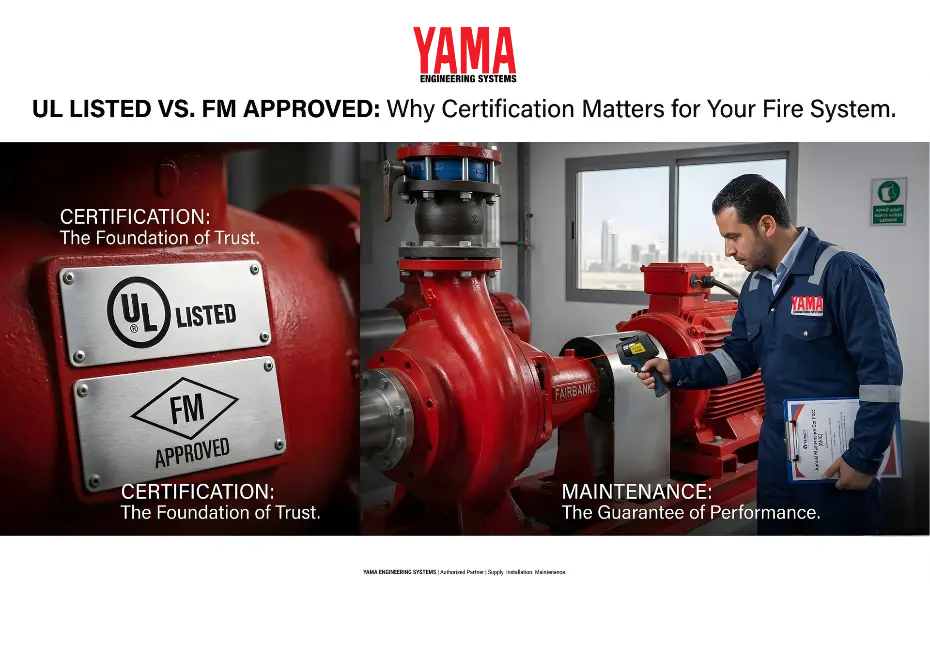
What is UL (Underwriters Laboratories)?
"UL is a global safety science company. A 'UL Listed' fire pump has been rigorously tested to ensure it won't fail under extreme heat or pressure. In Egypt, Civil Defense often requires UL listing for critical infrastructure like hospitals and malls to ensure public safety."
What is FM (Factory Mutual)?
"FM Approval is even stricter. It is driven by insurance companies. If you want your building insured by a global carrier, they will likely demand FM Approved equipment. It proves your system has the highest reliability rating in the world."
Why "Civil Defense Approved" Isn't Enough
"Local approval is the minimum legal requirement, but UL/FM is the performance guarantee. At Yama ES, we supply Pentair Fairbanks pumps which carry both listings. This double layer of certification protects your investment and ensures that in a real fire, the water will flow."
The Role of Maintenance (AMC)
"Even the best UL pump will fail if neglected. This is why Yama ES offers Annual Maintenance Contracts (AMC). We keep your certified equipment in certified condition, ensuring you pass your annual safety license renewal."
Upgrade your safety standards. Ask Yama ES about our UL/FM certified product range.
Horizontal Split Case vs. Vertical Turbine Fire Pumps: Which Does Your Project Need?
Choosing the correct fire pump is the most critical decision in your fire protection strategy. While both move high volumes of water, their applications are entirely different. Yama Engineering Systems, an authorized distributor for Pentair Fairbanks, breaks down the exact differences so you can specify the right UL/FM listed pump for your Egyptian infrastructure project.
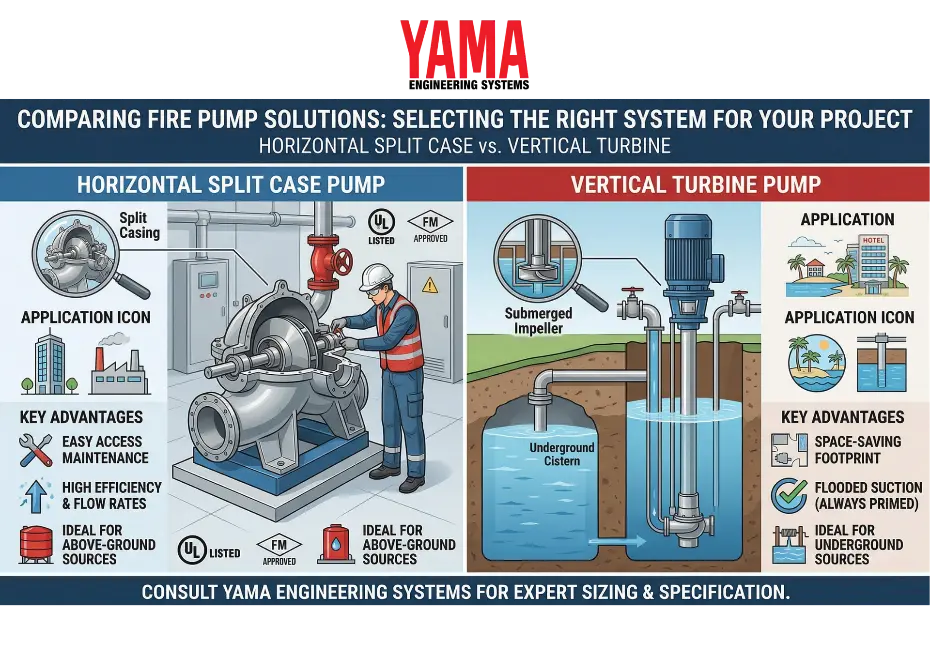
What is a Horizontal Split Case Fire Pump?
The horizontal split case pump is the industry workhorse. The casing is split horizontally, allowing engineers to remove the top half for maintenance without disconnecting the suction or discharge piping.
- Best Used For: Commercial towers, shopping malls, and large industrial factories where water is supplied from above-ground tanks or municipal lines.
- The Advantage: Easier maintenance, high efficiency, and capable of massive flow rates (up to 7,000 GPM).
What is a Vertical Turbine Fire Pump?
When your water source is below ground, standard pumps cannot "pull" the water up reliably without losing prime. Vertical turbine pumps are submerged directly into the water source.
- Best Used For: Facilities utilizing underground water tanks, wells, or open bodies of water (like coastal resorts).
- The Advantage: Occupies less floor space in the mechanical room and guarantees flooded suction at all times, preventing air-lock during emergencies.
How to Choose?
It strictly comes down to your water source location and mechanical room space. Our engineering team at Yama ES regularly runs hydraulic calculations to help contractors select the exact Pentair Fairbanks model required to meet NFPA 20 standards.
Unsure which pump fits your mechanical room design? Contact the Yama ES technical team for a free sizing consultation.
Waterless Fire Protection: Why Data Centers Rely on Clean Agent Systems
A standard fire sprinkler system will save your building, but the water will destroy your servers, hard drives, and electrical panels. For critical infrastructure, water is not the answer. This is why top facilities in Cairo are upgrading to Clean Agent Fire Suppression systems.
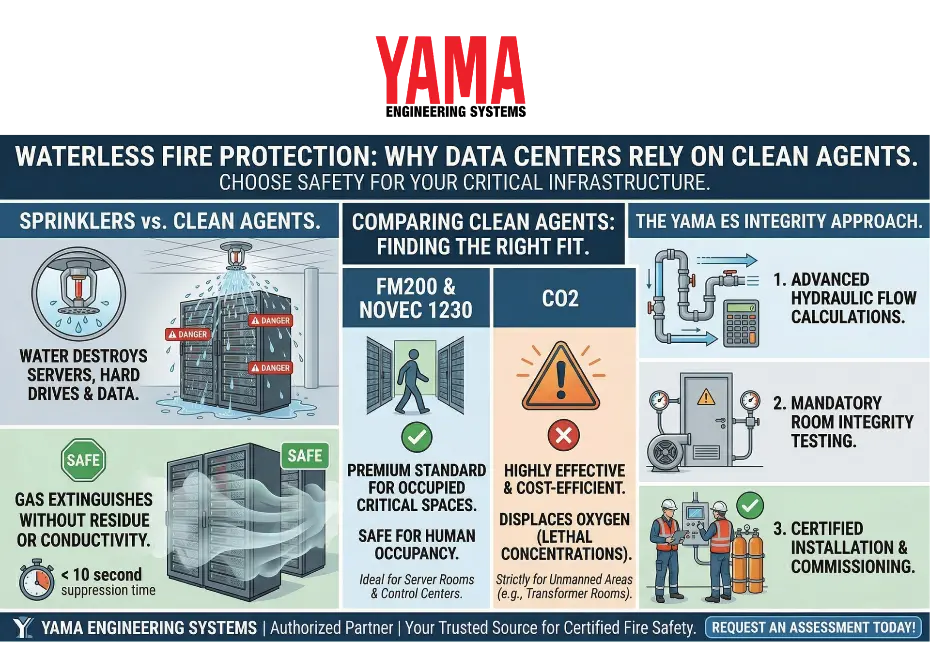
What is a Clean Agent Fire Suppression System?
Clean agents are electrically non-conductive, fast-acting gases that extinguish fires without leaving any residue. The system floods the room with gas (like FM200 or Novec 1230), disrupting the fire at the molecular level in under 10 seconds.
FM200 vs. CO2: What is the Difference?
- FM200 & Novec 1230: These are safe for human occupancy. If the system discharges while your IT staff is in the server room, they can safely evacuate. They are the premium standard for occupied critical spaces.
- CO2 Systems: Carbon dioxide is highly effective and cost-efficient, but it displaces oxygen and is lethal to humans in high concentrations. CO2 is strictly reserved for unmanned areas like transformer rooms and large generator enclosures.
The Yama ES Approach to Gas Suppression Installing the cylinders is only 50% of the job. A clean agent system requires a perfectly sealed room to maintain the correct gas concentration. Yama ES performs mandatory Room Integrity Testing and hydraulic flow calculations to ensure 100% suppression success.
Protect your data from both fire and water damage. Request a Clean Agent system assessment from Yama ES today.
Don’t leave your facility’s compliance to chance. Book a technical consultation with a YAMA ES certified engineer today and ensure your infrastructure meets the highest global standards. Book Your Consultation Now